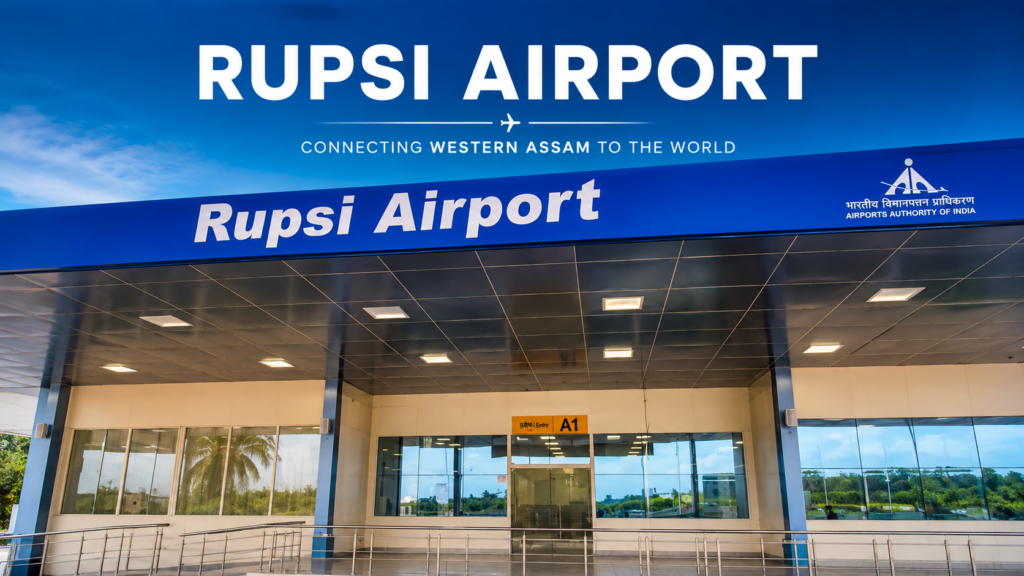
Airport History
Rupsi Airport is located in the Kokrajhar district of Assam, approximately 15 km from Dhubri town, and holds significant historical importance. The airport was originally constructed during World War II by the British Royal Air Force as a military airfield to support operations in the eastern theatre. After India’s independence, the airport witnessed limited civilian activity before gradually becoming non-operational for commercial flights.
Recognizing the strategic need to improve regional connectivity in western Assam, the Government of India approved the revival of Rupsi Airport under the Regional Connectivity Scheme (UDAN). The Airports Authority of India (AAI) undertook extensive modernization works, including runway rehabilitation, terminal construction, airfield infrastructure upgrades, and installation of modern navigation systems.
Commercial flight operations resumed in May 2021, marking a significant milestone in enhancing air connectivity for the Bodoland Territorial Region and western Assam. Today, Rupsi Airport serves as an important regional gateway supporting economic development, tourism, trade, and faster access to the northeastern states.
Airport Overview
Rupsi Airport is a domestic airport owned and operated by the Airports Authority of India (AAI). Developed under the UDAN scheme, the airport primarily caters to regional air travel and plays a crucial role in connecting western Assam with major Indian cities.
The airport serves the districts of Dhubri, Kokrajhar, Bongaigaon, Chirang, Goalpara, and adjoining regions. It also acts as an important transportation hub for the Bodoland Territorial Region, reducing travel time that was previously dependent on road and rail networks.
Currently, Rupsi Airport handles scheduled domestic services operated under regional connectivity initiatives. As passenger demand continues to grow, the airport is expected to play an increasingly important role in supporting tourism, agriculture, trade, and government connectivity projects across western Assam.
Airport Snapshot
| Parameter | Details |
| Airport Name | Rupsi Airport |
| IATA Code | RUP |
| ICAO Code | VERU |
| Airport Type | Domestic Airport |
| Owner | Airports Authority of India (AAI) |
| Operator | Airports Authority of India (AAI) |
| Location | Rupsi, Kokrajhar District, Assam |
| Elevation | Approximately 42 metres (138 ft) |
| Passenger Terminals | 1 |
| Runways | 1 |
| Runway Number | 05/23 |
| Runway Length | Approximately 1,830 metres |
| Runway Surface | Asphalt |
| Commercial Operations Started | May 2021 (after redevelopment under UDAN) |
| Primary Catchment | Kokrajhar, Dhubri, Goalpara, Bongaigaon, Chirang, Bodoland Territorial Region |
| Major Airlines | Alliance Air (services subject to schedule revisions) |
Market Intelligence
Rupsi Airport primarily serves a regional market with significant potential for future growth. The airport’s catchment area includes several districts with a combined population of millions, where air travel options were previously limited. Government investment through the UDAN scheme has substantially improved accessibility and is expected to stimulate business activity, tourism, and regional economic development.
The surrounding region has strong agricultural production, cross-border trade potential with Bangladesh, and growing government infrastructure investments. Tourism demand is supported by destinations such as Manas National Park, local cultural attractions, and the broader northeastern tourism circuit. Passenger traffic is expected to increase as connectivity expands and airline networks mature.
From a commercial perspective, the airport currently offers limited non-aeronautical infrastructure, presenting opportunities for future retail, food and beverage, passenger services, and advertising development as passenger volumes grow.
SirriS Intelligence Summary
Rupsi Airport represents a strategic long-term opportunity rather than a mature commercial aviation market. While current passenger volumes and airline operations remain modest, the airport occupies a critical position in western Assam and the Bodoland Territorial Region, where improved air connectivity is driving economic and social development.
For the Out-of-Home (OOH) advertising industry, Rupsi Airport currently offers limited immediate inventory potential. However, as regional connectivity expands under government initiatives and passenger traffic increases, the airport is likely to become an attractive location for targeted regional advertising, public information campaigns, tourism promotion, and local brand visibility.
From the SirriS perspective, Rupsi Airport should be monitored for future developments including passenger traffic growth, route expansion, infrastructure upgrades, commercial concessions, retail opportunities, and any advertising or media rights tenders issued by the Airports Authority of India. Its evolving role makes it a valuable airport to track within the broader northeastern aviation landscape.