Airport History
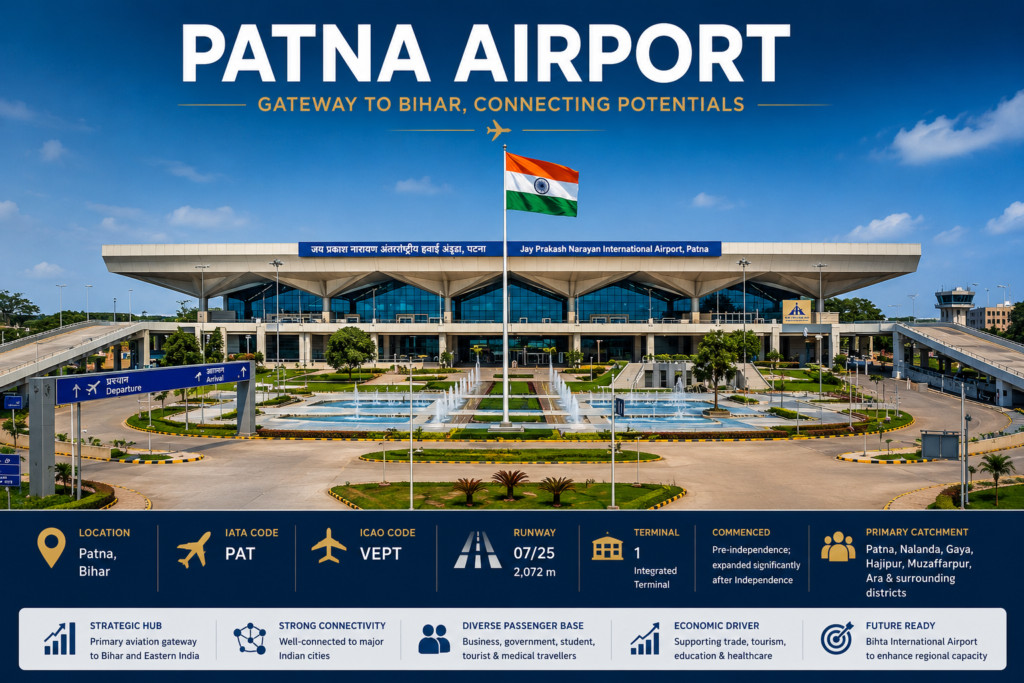
Patna Airport, officially known as Jay Prakash Narayan International Airport, is one of the oldest operating airports in eastern India and serves as the primary aviation gateway to the state of Bihar. Named after the renowned freedom fighter and social reformer Jay Prakash Narayan, the airport has played a significant role in connecting Bihar with major cities across India for several decades.
The airport’s origins date back to the pre-independence era when it served limited aviation operations. Following India’s independence, it gradually evolved into a major domestic airport, supporting government travel, business activities, education, healthcare, and tourism. Over the years, the Airports Authority of India (AAI) has undertaken multiple infrastructure upgrades, including terminal modernization, apron expansion, navigational improvements, and enhanced passenger facilities to accommodate increasing air traffic.
Despite being one of India’s busiest airports in terms of passenger density, Patna Airport faces operational constraints due to its limited land availability, short runway, and dense urban surroundings. To address the growing demand for air travel in Bihar, a new international airport is under development at Bihta, which is expected to complement Patna Airport in the future.
Airport Overview
Jay Prakash Narayan International Airport (IATA: PAT, ICAO: VEPT) is an international airport owned and operated by the Airports Authority of India (AAI). Located approximately 5 kilometres southwest of the city centre, the airport serves as the principal aviation hub for Bihar and one of the busiest airports in eastern India.
The airport provides scheduled domestic connectivity to all major metropolitan cities, including Delhi, Mumbai, Bengaluru, Kolkata, Hyderabad, Chennai, Pune, and Ahmedabad, along with limited international connectivity through seasonal and regional services. It serves a diverse passenger base comprising business travellers, government officials, students, medical travellers, tourists, and the large migrant workforce travelling between Bihar and other parts of India.
Patna Airport continues to witness steady passenger growth despite infrastructure limitations. Its strategic location within the state capital makes it a vital transportation hub, supporting Bihar’s economic development, governance, education, healthcare, and tourism sectors.
Airport Snapshot
| Parameter | Details |
| Airport Name | Jay Prakash Narayan International Airport |
| IATA Code | PAT |
| ICAO Code | VEPT |
| Airport Type | International Airport |
| Owner | Airports Authority of India (AAI) |
| Operator | Airports Authority of India (AAI) |
| Location | Patna, Bihar |
| Elevation | Approximately 52 metres (171 ft) |
| Passenger Terminals | 1 Integrated Terminal |
| Runways | 1 |
| Runway Number | 07/25 |
| Runway Length | 2,072 metres |
| Runway Surface | Asphalt |
| Commercial Operations Started | Pre-independence; expanded significantly after Independence |
| Primary Catchment | Patna, Nalanda, Gaya, Hajipur, Muzaffarpur, Ara, Bihar Sharif, and surrounding districts |
| Major Airlines | Air India, IndiGo, Akasa Air, SpiceJet |
Market Intelligence
Patna Airport serves as the primary aviation gateway to Bihar, one of India’s most populous states, and plays a pivotal role in regional connectivity and economic development. The airport supports a diverse mix of passenger segments, including government officials, business executives, students, medical travellers, tourists, and a substantial migrant workforce travelling between Bihar and major metropolitan cities. The airport’s strategic location within the state capital makes it an essential transportation hub for administrative, educational, healthcare, and commercial activities.
The airport benefits from a large and expanding catchment area supported by rapid urbanization, growing disposable incomes, and increasing demand for air travel. Bihar’s economy is driven by agriculture, food processing, education, healthcare, trade, construction, and a growing services sector, all of which contribute to consistent passenger traffic throughout the year. Tourism also contributes significantly, with visitors travelling to destinations such as Bodh Gaya, Nalanda, Rajgir, Vaishali, and Takht Sri Patna Sahib, one of Sikhism’s holiest shrines.
Despite facing operational constraints due to its short runway and limited expansion possibilities within the city, Patna Airport continues to record strong passenger demand. The planned development of Bihta International Airport is expected to further strengthen aviation infrastructure in the region while complementing Patna Airport’s operations. With sustained economic growth, improved connectivity, and rising passenger volumes, Patna Airport is expected to remain one of eastern India’s most strategically important aviation hubs.
SirriS Intelligence Summary
Jay Prakash Narayan International Airport is one of the most strategically significant airports in eastern India, serving as the primary aviation gateway to Bihar. Its central role in supporting government administration, commerce, education, healthcare, tourism, and regional mobility makes it a critical component of the state’s transportation infrastructure. Although constrained by limited land availability and operational challenges, the airport continues to experience robust passenger growth driven by strong economic and demographic fundamentals. The planned expansion of aviation infrastructure through the upcoming Bihta International Airport is expected to enhance the region’s overall connectivity while reinforcing Patna’s importance within India’s aviation network. From a SirriS perspective, Patna Airport represents a high-priority strategic airport with sustained long-term importance for aviation, infrastructure, commerce, and regional development.