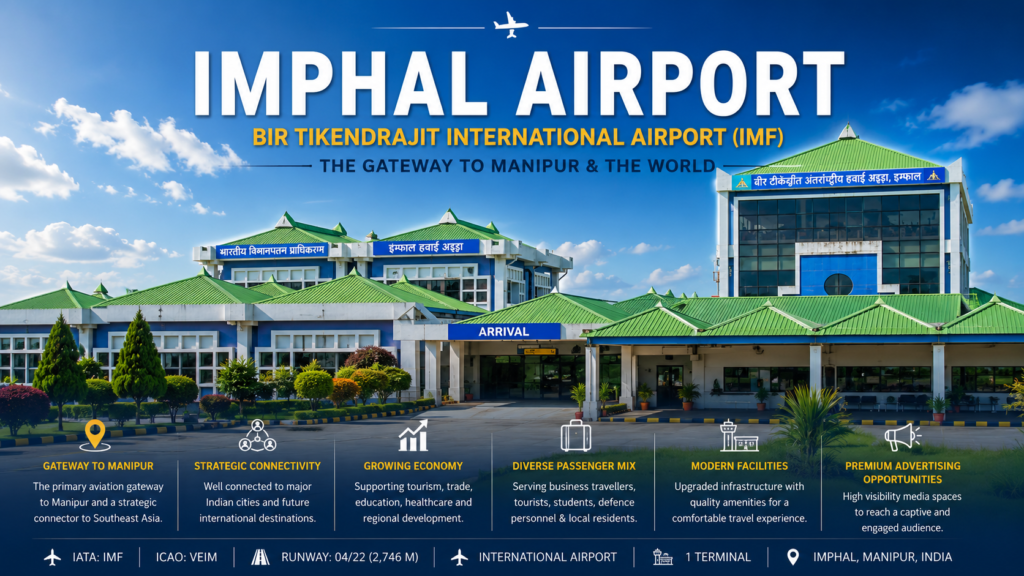
Airport History
Imphal Airport, officially known as Bir Tikendrajit International Airport, is the primary airport serving the state of Manipur and one of the most significant aviation hubs in Northeast India. Named after Bir Tikendrajit Singh, a revered freedom fighter and military leader of Manipur, the airport has played an essential role in connecting the region with the rest of the country for several decades.
The airport traces its origins to the Second World War, when it was developed as a military airfield due to Manipur’s strategic location near the Indo-Myanmar border. Following India’s independence, the airport was progressively expanded for civilian aviation, supporting the growing demand for passenger and cargo transportation across Northeast India.
Managed by the Airports Authority of India (AAI), Imphal Airport has undergone continuous modernization, including runway improvements, terminal expansion, upgraded navigation systems, and enhanced passenger facilities. In 2018, the airport was officially designated as an International Airport, recognising its strategic importance and future potential for cross-border connectivity with Southeast Asia under India’s Act East Policy. Today, it stands as the second international airport in Northeast India after Guwahati and continues to serve as a vital gateway to Manipur.
Airport Overview
Bir Tikendrajit International Airport is located approximately 8 kilometres south of Imphal city and serves as the principal aviation gateway to Manipur. Operated by the Airports Authority of India, the airport provides extensive domestic connectivity while being equipped to handle future international operations.
The airport offers scheduled flights connecting Imphal with major cities including Delhi, Kolkata, Guwahati, Bengaluru, Hyderabad, Silchar, Agartala, and other regional destinations. It plays a crucial role in facilitating government administration, defence operations, healthcare access, education, tourism, business travel, and regional trade.
Its strategic location near the India-Myanmar border makes the airport an important component of India’s connectivity initiatives with Southeast Asia. Supported by modern passenger facilities, upgraded operational infrastructure, and ongoing development projects, Imphal Airport is positioned to become a key aviation hub supporting economic growth and regional integration in Northeast India.
Airport Snapshot
| Parameter | Details |
| Airport Name | Bir Tikendrajit International Airport (Imphal Airport) |
| IATA Code | IMF |
| ICAO Code | VEIM |
| Airport Type | International Airport |
| Owner | Airports Authority of India |
| Operator | Airports Authority of India (AAI) |
| Location | Imphal, Manipur |
| Elevation | Approximately 774 metres (2,540 ft) |
| Passenger Terminals | 1 Integrated Passenger Terminal |
| Runways | 1 |
| Runway Number | 04/22 |
| Runway Length | Approximately 2,746 metres |
| Runway Surface | Asphalt |
| Commercial Operations | Scheduled Domestic Services with International Status |
| Primary Catchment | Manipur and adjoining regions of Northeast India |
| Major Airlines | IndiGo, Air India, Air India Express, Alliance Air |
Market Intelligence
Bir Tikendrajit International Airport is one of Northeast India’s most strategically significant airports, serving as the primary aviation gateway to Manipur and supporting connectivity across the eastern frontier of India. Its proximity to the India–Myanmar border positions the airport as a key component of the Government of India’s Act East Policy, with long-term potential to facilitate international trade, tourism, and regional economic integration with Southeast Asia. The airport caters to a broad passenger base comprising government officials, defence personnel, business travellers, students, healthcare travellers, tourists, and local residents.
The airport plays a critical role in supporting Manipur’s economy, which is driven by agriculture, handloom and handicrafts, sports, education, healthcare, government administration, and cross-border trade. Imphal’s growing importance as the administrative and commercial centre of the state has resulted in steady passenger demand throughout the year. Additionally, government investments in infrastructure, logistics, border trade, and regional connectivity are expected to further strengthen passenger growth over the coming decade.
Tourism continues to emerge as a major contributor to air travel demand. Manipur is renowned for attractions such as Loktak Lake, Keibul Lamjao National Park, Kangla Fort, INA Memorial Complex, Shirui Hills, Dzuko Valley (shared with Nagaland), and its vibrant cultural festivals. Adventure tourism, eco-tourism, heritage tourism, and sports tourism are steadily increasing, supported by state and central government initiatives to promote the Northeast as a tourism destination.
From a commercial perspective, Imphal Airport offers substantial opportunities for airport advertising and passenger engagement. Its modern terminal, captive audience, and growing passenger traffic create a favourable environment for brands across banking, automobiles, telecommunications, healthcare, education, tourism, hospitality, consumer goods, and government awareness campaigns. As international connectivity develops in the future, the airport’s commercial ecosystem is expected to expand significantly, enhancing its attractiveness for retailers, concessionaires, and airport media operators.
SirriS Intelligence Summary
From the SirriS perspective, Bir Tikendrajit International Airport is classified as a Strategic International Airport with high long-term growth potential. Although current operations are predominantly domestic, the airport’s international designation, strategic border location, and role within India’s Act East Policy position it as one of the most important future aviation assets in Northeast India.
The airport benefits from consistent passenger demand generated by government travel, defence operations, education, healthcare, business activities, and tourism. Ongoing investments in airport infrastructure, regional connectivity, and border trade initiatives are expected to support sustained passenger growth while strengthening Imphal’s role as an economic gateway between India and Southeast Asia.
For the Out-of-Home (OOH) advertising industry, Imphal Airport represents a high-potential emerging market. The airport provides advertisers with access to a diverse and influential passenger demographic within a controlled environment characterised by strong visibility and extended dwell times. With relatively limited media clutter compared to larger metropolitan airports, brands can achieve greater audience engagement and recall. Sectors including tourism, banking, telecommunications, healthcare, education, consumer goods, automobiles, and public sector organisations are particularly well-positioned to leverage airport media opportunities.
Overall, Bir Tikendrajit International Airport represents a high-value strategic aviation asset with excellent long-term prospects. Its combination of strategic location, modern infrastructure, growing tourism, expanding regional connectivity, and future international potential makes it one of Northeast India’s most promising airports for aviation stakeholders, airport media operators, concessionaires, and businesses seeking long-term opportunities in the region.