
Airport History
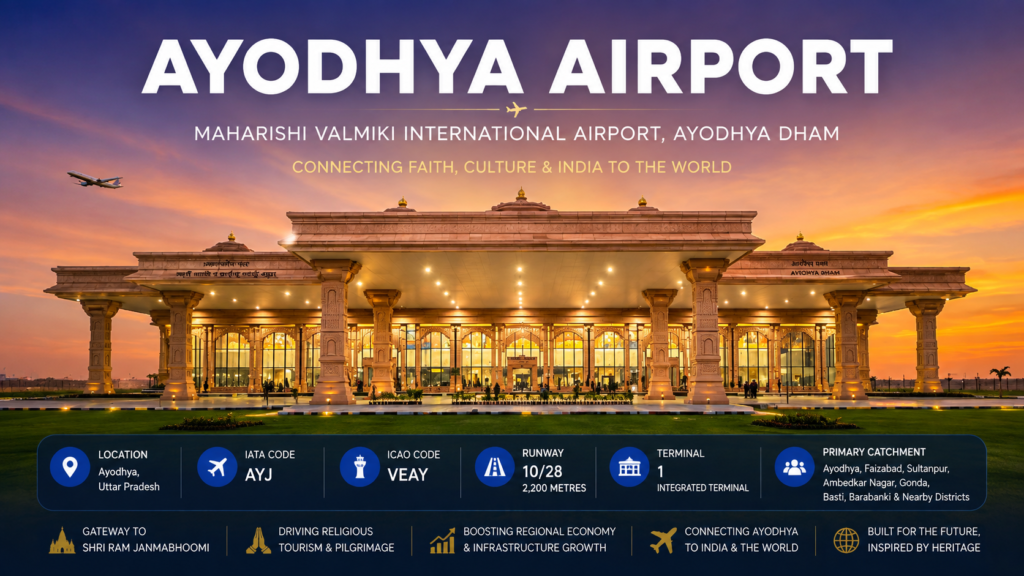
Maharishi Valmiki International Airport, Ayodhya Dham, is one of India’s newest international airports and a landmark infrastructure project developed to support the rapid transformation of Ayodhya into a global religious, cultural, and tourism destination. The airport was developed by upgrading the existing Ayodhya airstrip into a modern international airport as part of the Government of India’s vision to enhance connectivity to one of Hinduism’s holiest cities.
The airport was inaugurated in December 2023, coinciding with the development of the Shri Ram Janmabhoomi Temple and large-scale infrastructure projects across Ayodhya. The first phase included a modern passenger terminal inspired by traditional temple architecture, expanded runway infrastructure, and state-of-the-art passenger amenities.
Designed with future expansion in mind, the airport is planned to be developed in multiple phases to accommodate the anticipated surge in domestic and international pilgrims, tourists, and business travellers over the coming decades.
Airport Overview
Maharishi Valmiki International Airport, Ayodhya Dham, is an international airport owned and operated by the Airports Authority of India (AAI). Located approximately 8 kilometres from the city centre, it serves Ayodhya and the surrounding districts of eastern Uttar Pradesh.
The airport has been developed to support one of India’s largest religious tourism markets while also improving regional connectivity for residents, businesses, educational institutions, and government agencies. It provides direct connectivity to several major Indian cities, with international operations expected to expand progressively.
Architecturally, the terminal reflects Ayodhya’s spiritual heritage through temple-inspired design elements, traditional artwork, and sustainable construction practices, creating a distinctive passenger experience aligned with the city’s cultural identity.
Airport Snapshot
| Parameter | Details |
| Airport Name | Maharishi Valmiki International Airport, Ayodhya Dham |
| IATA Code | AYJ |
| ICAO Code | VEAY |
| Airport Type | International Airport |
| Owner | Airports Authority of India (AAI) |
| Operator | Airports Authority of India (AAI) |
| Location | Ayodhya, Uttar Pradesh |
| Elevation | Approximately 93 metres (305 ft) |
| Passenger Terminals | 1 (Phase-I Integrated Terminal) |
| Runways | 1 |
| Runway Number | 10/28 |
| Runway Length | Approximately 2,200 metres (planned for future extension) |
| Runway Surface | Asphalt |
| Commercial Operations | Commenced in December 2023 |
| Primary Catchment | Ayodhya, Faizabad, Sultanpur, Ambedkar Nagar, Gonda, Basti, Barabanki and surrounding districts |
| Major Airlines | Air India, IndiGo, Air India Express, SpiceJet, Akasa Air (subject to schedule changes) |
Market Intelligence
Ayodhya Airport serves one of the fastest-growing aviation markets in India, driven primarily by religious tourism. The inauguration of the Shri Ram Janmabhoomi Temple has transformed Ayodhya into a global pilgrimage destination, attracting millions of visitors annually from across India and abroad.
The airport’s catchment extends beyond Ayodhya, serving multiple districts across eastern Uttar Pradesh. Passenger demand is expected to be driven by religious pilgrims, leisure tourists, business travellers, government officials, educational institutions, and the Indian diaspora.
The airport is supported by significant investments in highways, railway infrastructure, urban development, hotels, hospitality, and tourism facilities. These complementary developments are expected to sustain long-term passenger growth and create opportunities across hospitality, retail, logistics, transportation, and commercial services.
With planned future expansion, the airport is expected to handle substantially higher passenger volumes and additional international routes, strengthening its role as a major aviation gateway in northern India.
SirriS Intelligence Summary
Maharishi Valmiki International Airport, Ayodhya Dham, is one of India’s most strategically significant greenfield airport developments of the decade. Its importance extends beyond aviation, serving as a catalyst for religious tourism, urban transformation, regional economic development, and infrastructure growth in eastern Uttar Pradesh.
The airport is uniquely positioned to benefit from sustained year-round pilgrimage traffic associated with Ayodhya’s emergence as a global spiritual destination. Supported by extensive government investment in roads, railways, hospitality, and civic infrastructure, it is expected to become a major driver of economic activity in the region.
Although the airport is currently operating its first phase, its master plan allows for substantial expansion in passenger capacity, terminal facilities, runway infrastructure, and international connectivity. As airline networks continue to grow, the airport is expected to evolve into one of North India’s leading pilgrimage and tourism gateways.