
Airport History
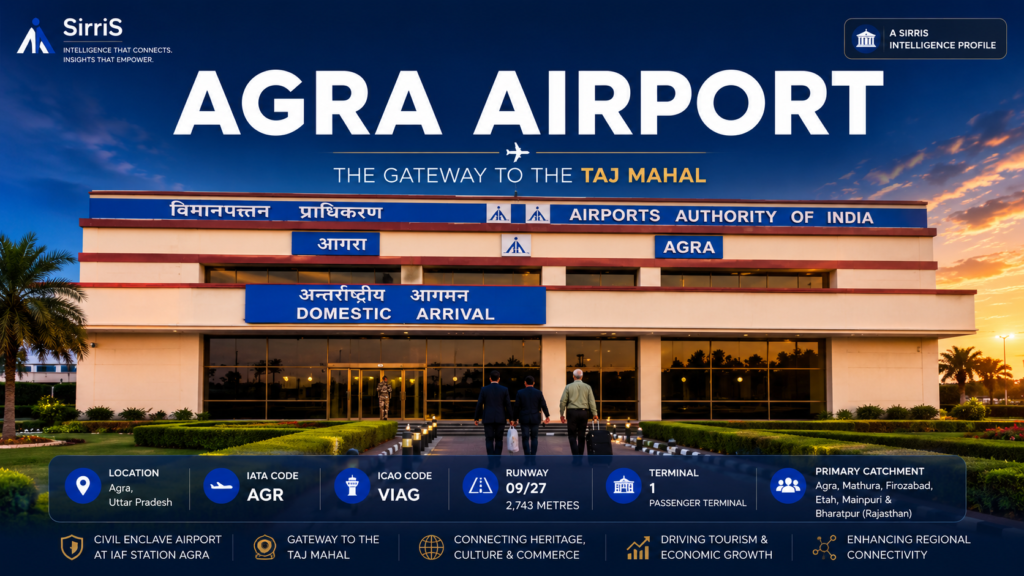
Agra Airport, also known as Pandit Deen Dayal Upadhyay Airport, is located in Agra, Uttar Pradesh, one of India’s most iconic tourist destinations. The airport operates as a civil enclave within the Indian Air Force’s Air Force Station Agra, one of the country’s largest and most strategically important military airbases.
Originally established for military operations, the airport has played a significant role in the Indian Air Force’s transport and logistics capabilities. Recognizing Agra’s importance as a global tourism destination, a civilian terminal was developed to facilitate commercial passenger services while maintaining military operations.
In recent years, the Airports Authority of India (AAI) has undertaken modernization initiatives to improve passenger facilities and enhance regional air connectivity. Commercial operations have expanded gradually under the Government of India’s regional aviation initiatives, supporting tourism, business travel, and economic development in western Uttar Pradesh.
Airport Overview
Agra Airport is a domestic airport operated as a civil enclave within Air Force Station Agra. The civilian terminal is managed by the Airports Authority of India (AAI), while the airfield remains under the control of the Indian Air Force.
The airport primarily serves Agra and neighbouring districts including Mathura, Firozabad, Etah, Mainpuri, and Bharatpur (Rajasthan). It acts as an important gateway for domestic tourists visiting the city’s UNESCO World Heritage monuments, particularly the Taj Mahal.
Besides tourism, the airport supports business travel, government movement, educational institutions, healthcare access, and regional commerce. Its strategic location within the Golden Triangle tourism circuit (Delhi–Agra–Jaipur) further enhances its importance in India’s aviation network.
Airport Snapshot
| Parameter | Details |
| Airport Name | Agra Airport (Pandit Deen Dayal Upadhyay Airport) |
| IATA Code | AGR |
| ICAO Code | VIAG |
| Airport Type | Domestic Airport (Civil Enclave) |
| Owner | Indian Air Force |
| Civil Operator | Airports Authority of India (AAI) |
| Location | Agra, Uttar Pradesh |
| Elevation | Approximately 169 metres (554 ft) |
| Passenger Terminal | 1 |
| Runways | 1 |
| Runway Number | 09/27 |
| Runway Length | Approximately 2,743 metres |
| Runway Surface | Asphalt |
| Commercial Operations | Scheduled Domestic Passenger Services |
| Primary Catchment | Agra, Mathura, Firozabad, Etah, Mainpuri, Bharatpur and surrounding regions |
| Major Airlines | IndiGo, Air India Express (subject to schedule changes) |
Market Intelligence
Agra Airport serves one of India’s largest tourism markets. Agra attracts millions of domestic and international visitors annually due to the Taj Mahal, Agra Fort, Fatehpur Sikri, Itmad-ud-Daulah, and several Mughal heritage sites. The city’s position within India’s Golden Triangle tourism circuit significantly contributes to passenger demand.
Beyond tourism, Agra is an important centre for leather manufacturing, handicrafts, marble inlay work, footwear, education, and small-scale industries. The airport supports business travel, government administration, hospitality, and conference tourism.
Passenger demand is driven by a combination of leisure travel, heritage tourism, business visits, educational travel, and government movement. Continued investments in tourism infrastructure, expressways, and regional connectivity are expected to strengthen the airport’s role in the coming years.
Being a civil enclave, future infrastructure expansion will continue to be coordinated with Indian Air Force operational requirements. Nevertheless, increasing airline interest and tourism growth provide strong long-term prospects for enhanced connectivity and passenger services.
SirriS Intelligence Summary
Agra Airport is one of India’s most strategically important tourism airports despite its relatively modest commercial operations. As the primary air gateway to the Taj Mahal—one of the New Seven Wonders of the World—the airport holds exceptional national and international significance.
Its location within the Delhi–Agra–Jaipur Golden Triangle, combined with Agra’s strong tourism economy and growing regional infrastructure, positions the airport as a key catalyst for economic development in western Uttar Pradesh. The airport also benefits from its role in supporting business travel, education, healthcare, and government connectivity.
While civilian operations are constrained by its shared use with the Indian Air Force, ongoing investments in tourism infrastructure and regional aviation are expected to drive sustained growth in passenger traffic and airline connectivity. Future enhancements to terminal facilities and route networks could significantly strengthen Agra’s position as a major domestic tourism gateway.