Airport History
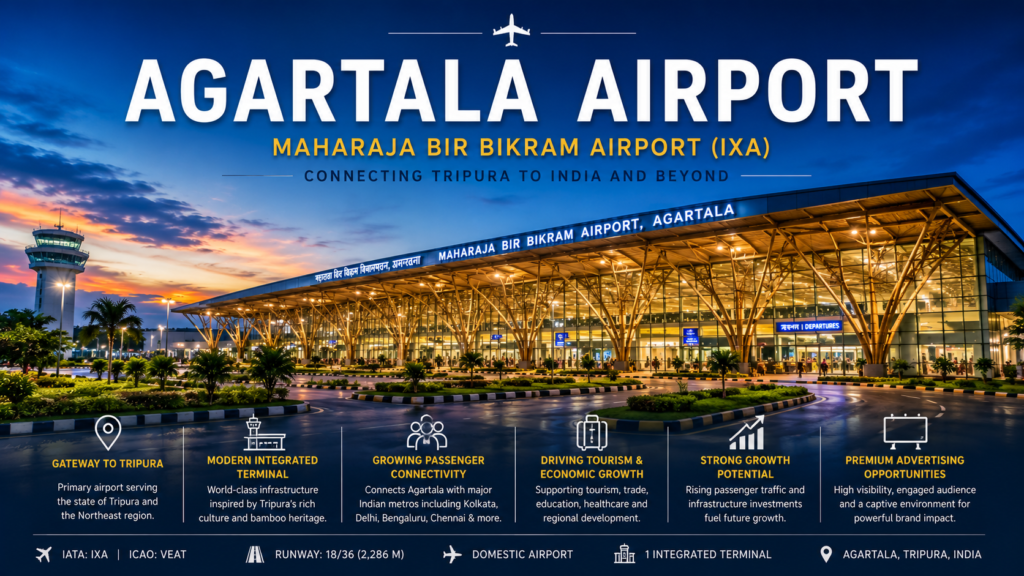
Agartala Airport, officially known as Maharaja Bir Bikram Airport (MBB Airport), is the primary airport serving the state of Tripura. Named after Maharaja Bir Bikram Kishore Manikya Bahadur, the last ruling king of the erstwhile princely state of Tripura, the airport has played a pivotal role in the region’s aviation history and socio-economic development.
Originally established during the Second World War as a military airfield, the airport was later adapted for civil aviation to improve connectivity between Tripura and the rest of India. Following the establishment of the Airports Authority of India (AAI), the airport underwent continuous modernization to accommodate increasing passenger traffic and larger aircraft.
A significant milestone in the airport’s development was the inauguration of its new integrated passenger terminal in 2022. Designed to reflect Tripura’s rich cultural heritage and traditional bamboo architecture, the terminal substantially increased passenger handling capacity while enhancing operational efficiency and passenger experience. Today, Maharaja Bir Bikram Airport is the second busiest airport in Northeast India after Guwahati and serves as the principal aviation gateway to Tripura.
Airport Overview
Maharaja Bir Bikram Airport is a domestic airport located approximately 12 kilometres northwest of Agartala city. Operated by the Airports Authority of India, the airport provides essential air connectivity between Tripura and major metropolitan cities across India, facilitating passenger travel, commerce, tourism, and government administration.
The airport serves as a critical transportation hub for the state due to Tripura’s geographical location, bordered on three sides by Bangladesh. It supports a growing network of domestic flights operated by leading Indian carriers connecting Agartala with cities such as Kolkata, Delhi, Guwahati, Bengaluru, Chennai, Imphal, and other regional destinations.
The modern integrated terminal, equipped with advanced passenger processing systems and sustainable design features, has positioned the airport to meet future traffic demand while significantly improving passenger comfort. As Tripura continues to witness growth in tourism, infrastructure development, trade, education, and healthcare, Agartala Airport remains central to the state’s economic and regional connectivity.
Airport Snapshot
| Parameter | Details |
| Airport Name | Maharaja Bir Bikram Airport (Agartala Airport) |
| IATA Code | IXA |
| ICAO Code | VEAT |
| Airport Type | Domestic Airport |
| Owner | Airports Authority of India |
| Operator | Airports Authority of India (AAI) |
| Location | Agartala, Tripura |
| Elevation | Approximately 14 metres (46 ft) |
| Passenger Terminals | 1 Integrated Passenger Terminal |
| Runways | 1 |
| Runway Number | 18/36 |
| Runway Length | Approximately 2,286 metres |
| Runway Surface | Asphalt |
| Commercial Operations | Scheduled Domestic Services |
| Primary Catchment | Tripura and adjoining regions of Northeast India |
| Major Airlines | IndiGo, Air India, Air India Express, Akasa Air |
Market Intelligence
Maharaja Bir Bikram Airport serves as the primary aviation gateway to Tripura and is one of the fastest-growing regional airports in Northeast India. The airport plays a pivotal role in connecting the state with the country’s major economic centres, supporting government administration, business activities, education, healthcare, and tourism. Given Tripura’s geographical location, with nearly 85% of its boundary adjoining Bangladesh, air connectivity is essential for ensuring efficient passenger movement and regional integration.
The airport caters to a diverse passenger profile that includes government officials, business travellers, students, medical travellers, defence personnel, and tourists. Agartala’s emergence as the administrative, educational, and commercial centre of Tripura has led to a steady increase in passenger demand. Improvements in road connectivity, economic development initiatives under the Act East Policy, and growing investments in infrastructure are expected to further strengthen air travel demand in the coming years.
Tourism is becoming an increasingly important contributor to passenger traffic. Attractions such as Ujjayanta Palace, Neermahal Water Palace, Tripura Sundari Temple, Unakoti, Sepahijala Wildlife Sanctuary, Jampui Hills, and several eco-tourism destinations are attracting a growing number of domestic visitors. Government initiatives promoting cultural tourism, heritage conservation, and cross-border trade are expected to support continued growth in visitor arrivals.
From a commercial perspective, Maharaja Bir Bikram Airport presents a promising opportunity for airport advertising and retail businesses. The modern integrated terminal provides enhanced advertising infrastructure and improved passenger circulation, creating an effective environment for brand communication. With a captive audience and increasing passenger volumes, the airport offers attractive opportunities for sectors including banking, telecommunications, automobiles, consumer goods, healthcare, education, tourism, hospitality, and government awareness campaigns. As Tripura’s economy continues to diversify and connectivity expands, the airport’s commercial significance is expected to strengthen further.
SirriS Intelligence Summary
From the SirriS perspective, Maharaja Bir Bikram Airport is classified as a Strategic Regional Airport with significant importance in Northeast India’s aviation ecosystem. While its passenger traffic is lower than that of India’s metropolitan airports, its strategic location, expanding infrastructure, and role as Tripura’s primary aviation gateway position it as a key asset for long-term regional development.
The airport benefits from a modern integrated terminal, improving airline connectivity, and sustained government investment in the Northeast under national infrastructure and connectivity programmes. These factors are expected to support consistent passenger growth and enhance the airport’s operational capacity over the coming decade.
For the Out-of-Home (OOH) advertising industry, Maharaja Bir Bikram Airport represents an emerging high-potential market. The airport provides advertisers with access to a diverse audience comprising government officials, business professionals, tourists, students, healthcare travellers, and local residents within a controlled, high-dwell-time environment. The relatively uncluttered media landscape, combined with the upgraded terminal infrastructure, enables brands to achieve strong visibility and effective audience engagement.
Overall, Maharaja Bir Bikram Airport demonstrates excellent long-term potential as a regional aviation hub. Its strategic border location, improving infrastructure, growing passenger demand, and expanding commercial ecosystem make it an attractive destination for airport media operators, concessionaires, aviation stakeholders, and businesses seeking to establish a presence in Northeast India. As connectivity and economic activity continue to increase, the airport is well-positioned to become one of the region’s most commercially significant aviation assets.