Airport History
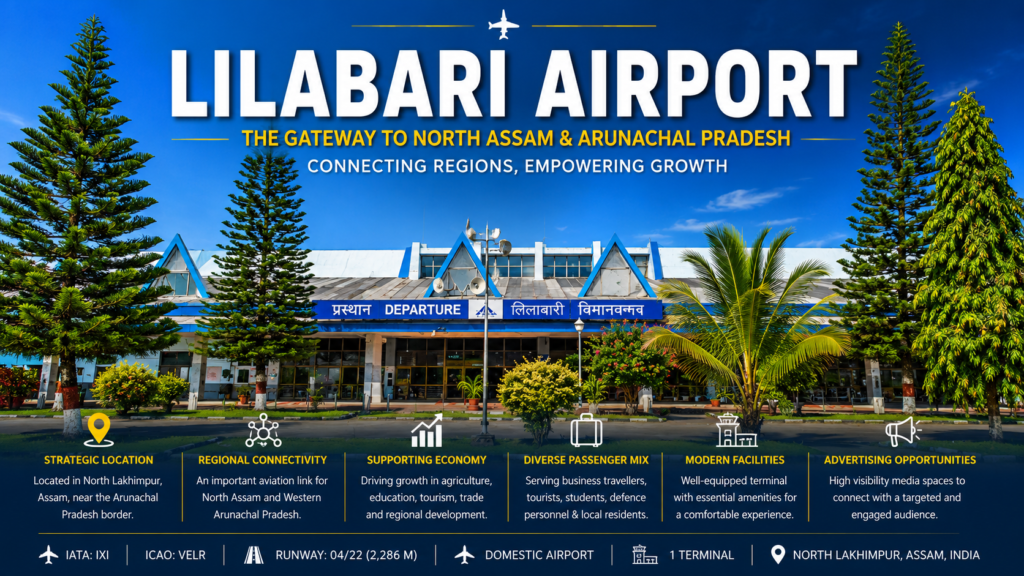
Lilabari Airport is a domestic airport located in North Lakhimpur district of Assam and has historically served as the primary aviation gateway to Arunachal Pradesh before the inauguration of Donyi Polo Airport in 2022. Strategically positioned along the Assam–Arunachal Pradesh border, the airport has played a vital role in improving connectivity to one of India’s most remote and geographically challenging regions.
Originally developed as a regional airstrip, Lilabari Airport was brought under the management of the Airports Authority of India (AAI) to strengthen air connectivity across Northeast India. Over the years, the airport has undergone several infrastructure upgrades, including runway improvements, terminal modernization, and enhanced navigation systems to support growing passenger demand and regional air services.
For decades, the airport served as the nearest commercial airport for Itanagar, the capital of Arunachal Pradesh, making it an important transportation hub for government officials, defence personnel, business travellers, tourists, students, and local residents. Although Donyi Polo Airport now serves the state capital directly, Lilabari Airport continues to play an important role in connecting North Assam and western Arunachal Pradesh while supporting the Government of India’s regional connectivity initiatives.
Airport Overview
Lilabari Airport is a domestic airport located approximately 8 kilometres from North Lakhimpur in Assam. Operated by the Airports Authority of India, the airport serves the districts of North Lakhimpur, Dhemaji, and adjoining regions of Arunachal Pradesh.
The airport provides scheduled domestic services connecting the region with Kolkata and other destinations through regional airline operators. It supports passenger travel for government administration, education, healthcare, business, tourism, and defence establishments. Due to its proximity to Arunachal Pradesh, the airport continues to serve as an important alternative aviation gateway for western and central parts of the state.
Surrounded by the Brahmaputra Valley and Himalayan foothills, Lilabari Airport also supports tourism to destinations such as Ziro Valley, Along (Aalo), Daporijo, Mechuka, and various eco-tourism circuits across Arunachal Pradesh. As regional air connectivity expands under the UDAN (Ude Desh ka Aam Nagrik) scheme and infrastructure improvements continue across Northeast India, the airport is expected to retain its strategic importance within the region’s aviation network.
Airport Snapshot
| Parameter | Details |
| Airport Name | Lilabari Airport |
| IATA Code | IXI |
| ICAO Code | VELR |
| Airport Type | Domestic Airport |
| Owner | Airports Authority of India |
| Operator | Airports Authority of India (AAI) |
| Location | North Lakhimpur, Assam |
| Elevation | Approximately 101 metres (330 ft) |
| Passenger Terminals | 1 |
| Runways | 1 |
| Runway Number | 04/22 |
| Runway Length | Approximately 2,286 metres |
| Runway Surface | Asphalt |
| Commercial Operations | Scheduled Domestic Services |
| Primary Catchment | North Lakhimpur, Dhemaji, Western Arunachal Pradesh |
| Major Airlines | Alliance Air |
Market Intelligence
Lilabari Airport occupies a unique position in Northeast India’s aviation landscape due to its strategic location near the Assam–Arunachal Pradesh border. While the opening of Donyi Polo Airport has shifted a portion of passenger traffic from Itanagar, Lilabari continues to serve as an important regional airport supporting North Assam and western Arunachal Pradesh. The airport remains an essential transportation link for government officials, defence personnel, students, business travellers, healthcare patients, and local residents who depend on reliable air connectivity in a region where terrain often makes surface transportation time-consuming.
The airport supports the economic activities of North Assam, including agriculture, tea cultivation, small-scale industries, education, government services, and regional trade. It also plays a supporting role in facilitating logistics and administrative travel to neighbouring districts and border areas. Ongoing investments in road infrastructure and the Government of India’s regional connectivity initiatives are expected to sustain passenger demand and improve integration with the broader transportation network.
Tourism continues to offer promising opportunities for the airport. Lilabari serves as an access point for travellers visiting Ziro Valley, Daporijo, Aalo, Mechuka, Namdapha National Park, and other scenic destinations in Arunachal Pradesh. The increasing popularity of eco-tourism, adventure tourism, tribal cultural experiences, and nature-based travel is expected to contribute to gradual growth in passenger traffic. The airport also benefits from seasonal tourist movement associated with festivals and outdoor activities across the Eastern Himalayan region.
From a commercial perspective, Lilabari Airport presents a niche but growing opportunity for airport advertising and passenger engagement. Although passenger volumes are relatively modest, the airport provides access to a targeted audience comprising government officials, defence personnel, tourists, students, and business travellers within a controlled environment characterised by high visibility and longer passenger dwell times. Sectors such as tourism, hospitality, banking, telecommunications, education, healthcare, automobiles, and government awareness campaigns can effectively leverage airport media to reach regional audiences. As connectivity improves and tourism expands, the airport’s commercial value is expected to strengthen steadily.
SirriS Intelligence Summary
From the SirriS perspective, Lilabari Airport is classified as a Strategic Regional Airport with continued importance in Northeast India’s regional aviation ecosystem. Although it no longer serves as the primary gateway to Arunachal Pradesh’s capital, the airport remains a critical transportation asset for North Assam and western Arunachal Pradesh, supporting regional mobility, economic activity, tourism, and government operations.
The airport benefits from stable passenger demand generated by government administration, education, healthcare, defence movement, and regional business travel. Continued investments in regional connectivity under the UDAN scheme, improvements in road infrastructure, and growing tourism across the Eastern Himalayas are expected to sustain its long-term relevance within the domestic aviation network.
For the Out-of-Home (OOH) advertising industry, Lilabari Airport represents a specialised regional market with access to a well-defined and influential passenger demographic. The airport’s relatively uncluttered media environment enables advertisers to achieve high visibility and stronger brand recall among travellers. Industries including tourism, hospitality, banking, education, telecommunications, healthcare, consumer goods, and public sector organisations can benefit from targeted airport advertising opportunities.
Overall, Lilabari Airport should be regarded as a high-potential regional aviation asset that complements the expanding airport infrastructure of Northeast India. Its strategic border location, established passenger base, growing tourism potential, and continued role in regional connectivity make it an attractive airport for aviation stakeholders, airport media operators, concessionaires, and businesses seeking long-term opportunities in the northeastern region.