Airport History
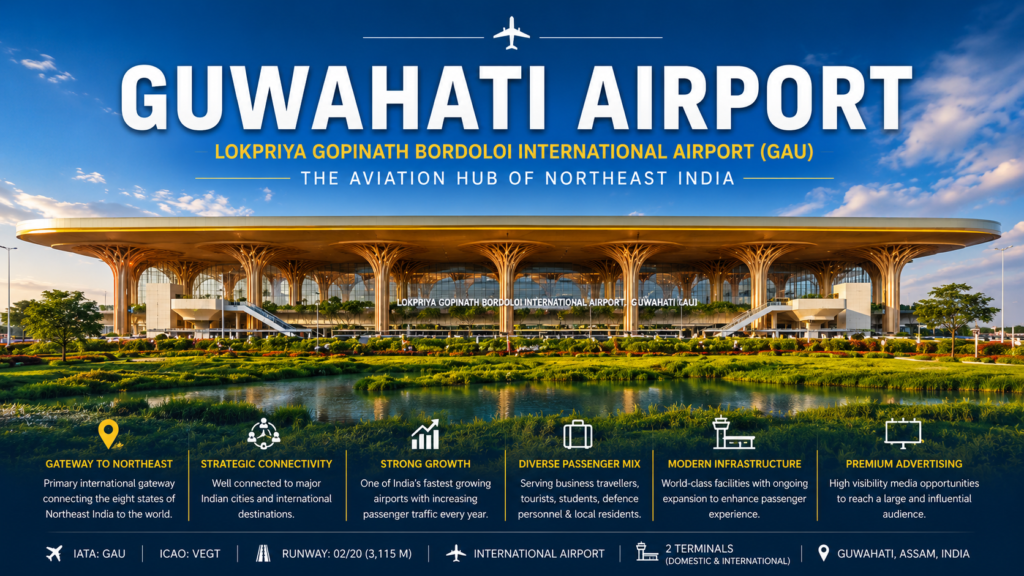
Lokpriya Gopinath Bordoloi International Airport (LGBI Airport), popularly known as Guwahati Airport, is the largest and busiest airport in Northeast India. Located at Borjhar, approximately 26 kilometres from the city centre, the airport serves as the primary aviation gateway to the eight Northeastern states and plays a vital role in connecting the region with the rest of India and international destinations.
Originally established during the Second World War as a military airfield, the airport was later developed for civilian operations to meet the growing transportation needs of Northeast India. In 1999, it was renamed Lokpriya Gopinath Bordoloi International Airport in honour of Assam’s first Chief Minister and Bharat Ratna awardee, Gopinath Bordoloi.
Over the past two decades, the airport has undergone significant modernization, including expansion of terminal facilities, runway improvements, cargo infrastructure, and passenger amenities. In 2021, the airport was leased to Adani Airport Holdings Limited under a public-private partnership model, marking a new phase of infrastructure development. Today, the airport continues to evolve with plans for a world-class integrated terminal designed to support future passenger growth and strengthen its role as the aviation hub of Northeast India.
Airport Overview
Lokpriya Gopinath Bordoloi International Airport is an international airport serving Guwahati, the largest city in Assam. Operated by Adani Airport Holdings Limited under a long-term concession from the Airports Authority of India (AAI), the airport is the busiest airport in Northeast India and one of the fastest-growing airports in the country.
The airport provides extensive domestic connectivity to major metropolitan cities including Delhi, Mumbai, Bengaluru, Chennai, Hyderabad, Kolkata, Pune, Ahmedabad, Jaipur, Lucknow, and several regional destinations across Northeast India. It also operates international flights connecting Guwahati with destinations such as Paro, Singapore, Bangkok, and other international markets as services continue to expand.
As the primary aviation hub for the Northeast, the airport supports passenger travel, cargo movement, tourism, government administration, defence operations, trade, education, healthcare, and regional economic integration. Continuous investments in airport infrastructure, technology, sustainability, and passenger services are positioning Guwahati Airport as one of India’s emerging aviation gateways.
Airport Snapshot
| Parameter | Details |
| Airport Name | Lokpriya Gopinath Bordoloi International Airport |
| IATA Code | GAU |
| ICAO Code | VEGT |
| Airport Type | International Airport |
| Owner | Airports Authority of India |
| Operator | Adani Airport Holdings Limited |
| Location | Guwahati, Assam |
| Elevation | Approximately 49 metres (162 ft) |
| Passenger Terminals | 2 (Domestic & International operations) |
| Runways | 1 |
| Runway Number | 02/20 |
| Runway Length | Approximately 3,115 metres |
| Runway Surface | Asphalt |
| Commercial Operations | Scheduled Domestic & International Services |
| Primary Catchment | Assam and the eight Northeastern States |
| Major Airlines | IndiGo, Air India, Air India Express, Akasa Air, SpiceJet, Alliance Air, Drukair, Thai AirAsia (seasonal/subject to operations) |
Market Intelligence
Lokpriya Gopinath Bordoloi International Airport is the undisputed aviation hub of Northeast India, serving as the principal gateway for more than 45 million people across the region. Its strategic location in Guwahati, the commercial capital of the Northeast, enables the airport to support a diverse mix of passenger traffic including business executives, government officials, defence personnel, tourists, students, healthcare travellers, and international visitors. As the largest airport in the region, it acts as a connecting hub for numerous domestic and regional destinations, making it one of India’s most strategically important airports outside the metropolitan cities.
The airport plays a critical role in driving the economic development of Northeast India by facilitating trade, commerce, tourism, logistics, and investment. Guwahati has emerged as the region’s financial, educational, healthcare, and administrative centre, generating substantial year-round business travel. Major industries including tea, petroleum, natural gas, pharmaceuticals, logistics, infrastructure, information technology, and retail contribute significantly to passenger movement. The airport also serves as an important logistics gateway supporting cargo movement to and from the Northeastern states.
Tourism is another major contributor to passenger traffic. Guwahati serves as the gateway to renowned destinations such as Kaziranga National Park, Manas National Park, Majuli River Island, Kamakhya Temple, Shillong, Tawang, Cherrapunji, and several eco-tourism destinations across the Northeast. Growing domestic tourism, international interest in the region, and government initiatives promoting the Act East Policy continue to strengthen demand for air travel.
From a commercial standpoint, Guwahati Airport represents one of the strongest airport advertising markets among non-metro airports in India. Its consistently high passenger volumes, expanding international connectivity, premium retail environment, and long passenger dwell times create exceptional opportunities for Out-of-Home (OOH) advertising. Brands across banking, automobiles, telecommunications, tourism, hospitality, aviation, consumer goods, healthcare, education, luxury retail, and government campaigns benefit from access to a large, diverse, and high-value audience. The upcoming integrated terminal and continued infrastructure investments are expected to significantly increase commercial inventory and enhance advertising potential in the coming years.
SirriS Intelligence Summary
From the SirriS perspective, Lokpriya Gopinath Bordoloi International Airport is classified as a Tier-1 Strategic International Airport and the primary aviation hub of Northeast India. The airport’s strategic importance extends beyond Assam, serving as the principal gateway for all eight Northeastern states and playing a crucial role in India’s regional connectivity, economic integration, tourism development, and cross-border trade.
The airport benefits from sustained passenger growth driven by increasing airline connectivity, expanding domestic and international routes, strong regional economic development, and continuous investments under private sector management. The development of a new world-class integrated terminal is expected to substantially enhance passenger handling capacity, improve operational efficiency, and strengthen Guwahati’s position as a leading aviation hub in eastern India.
For the Out-of-Home (OOH) advertising industry, Guwahati Airport is one of the most commercially attractive airports in India’s non-metro category. Its large passenger base, premium traveller profile, extensive dwell times, and modern airport environment provide advertisers with excellent opportunities to engage business leaders, government officials, affluent leisure travellers, students, and international visitors. The airport’s strategic role within the Northeast also enables brands to achieve regional market penetration through a single, high-impact advertising platform.
Overall, Guwahati Airport represents a high-value aviation and commercial asset with outstanding long-term growth potential. Its strategic location, expanding infrastructure, robust passenger traffic, strong regional economy, and growing international connectivity make it one of the most important airports in India’s aviation ecosystem. For airport media operators, concessionaires, infrastructure developers, and aviation stakeholders, Guwahati Airport offers one of the most compelling commercial opportunities in the country.