Airport History
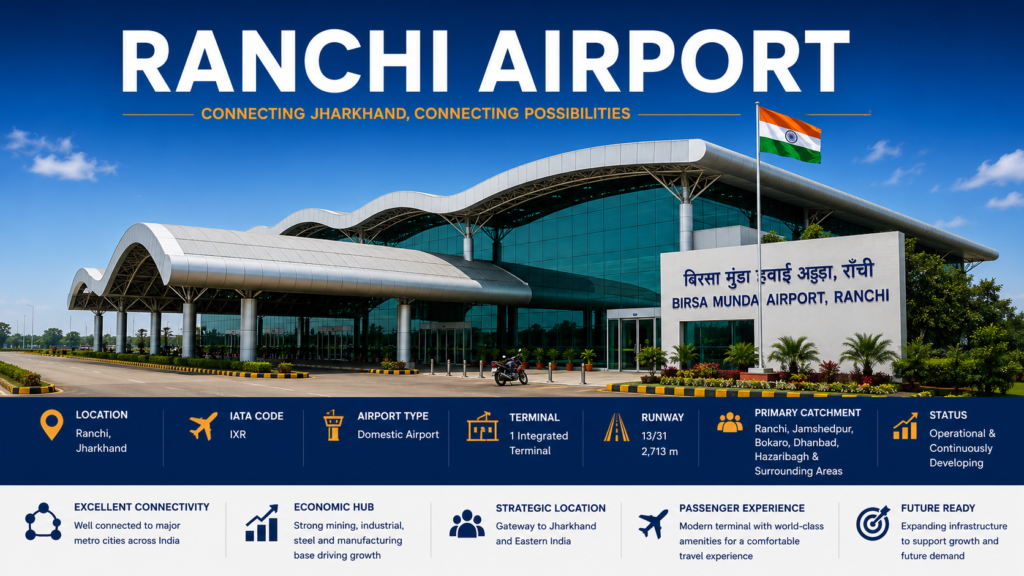
Birsa Munda Airport, popularly known as Ranchi Airport, is the primary airport serving the state of Jharkhand. Named after the revered tribal freedom fighter Birsa Munda, the airport has evolved from a modest regional airfield into one of Eastern India’s important domestic airports. It plays a vital role in supporting Jharkhand’s administrative, industrial, mining, and tourism sectors.
Following the formation of Jharkhand as a separate state in 2000, Ranchi emerged as the state capital, leading to significant investments in aviation infrastructure. The Airports Authority of India (AAI) undertook major modernization initiatives, including the construction of a new integrated passenger terminal, runway improvements, apron expansion, and the installation of advanced air navigation systems to accommodate growing passenger demand.
Today, Birsa Munda Airport serves as the state’s principal aviation gateway, connecting Jharkhand to major metropolitan cities across India while facilitating business travel, government operations, education, healthcare, and tourism.
Airport Overview
Birsa Munda Airport is located approximately 7 kilometres from Ranchi city centre, providing convenient access to the state capital and surrounding districts. Owned and operated by the Airports Authority of India (AAI), the airport primarily handles scheduled domestic passenger services, charter operations, cargo movements, and government flights.
The airport features a modern integrated passenger terminal equipped with aerobridges, spacious check-in areas, security screening facilities, retail outlets, food and beverage services, passenger lounges, and other modern amenities designed to deliver an efficient travel experience.
Strategically located in Eastern India, Ranchi Airport serves as a key transportation hub for Jharkhand’s mining belt, industrial clusters, educational institutions, healthcare facilities, and government establishments. Its catchment area extends beyond Ranchi to cities including Jamshedpur, Bokaro, Dhanbad, Hazaribagh, Ramgarh, Gumla, Lohardaga, and neighbouring regions of Bihar, Odisha, Chhattisgarh, and West Bengal.
Airport Snapshot
| Parameter | Details |
| Airport Name | Birsa Munda Airport (Ranchi Airport) |
| IATA Code | IXR |
| ICAO Code | VERC |
| Airport Type | Domestic Airport |
| Owner | Airports Authority of India (AAI) |
| Operator | Airports Authority of India (AAI) |
| Location | Ranchi, Jharkhand |
| Elevation | Approximately 646 metres (2,120 ft) |
| Passenger Terminals | 1 Integrated Passenger Terminal |
| Runways | 1 |
| Runway Number | 13/31 |
| Runway Length | Approximately 2,713 metres |
| Runway Surface | Asphalt |
| Commercial Operations Started | Civil aviation operations commenced before Independence; major expansion and modernization undertaken after the formation of Jharkhand in 2000 |
| Primary Catchment | Ranchi, Jamshedpur, Bokaro, Dhanbad, Hazaribagh, Ramgarh, Gumla, Lohardaga, and surrounding regions |
| Major Airlines | IndiGo, Air India, Air India Express, Akasa Air |
Market Intelligence
Ranchi, the capital of Jharkhand, is one of Eastern India’s most important administrative and industrial centres. The city’s economy is driven by mining, steel manufacturing, heavy engineering, power generation, public sector enterprises, information technology, education, and healthcare. Jharkhand’s abundant reserves of coal, iron ore, copper, bauxite, limestone, and other minerals have positioned the state as a major contributor to India’s industrial economy, creating sustained demand for business travel throughout the year.
Birsa Munda Airport primarily serves corporate executives, government officials, mining professionals, industrial engineers, entrepreneurs, students, medical travellers, tourists, and visiting friends and relatives (VFR). The airport experiences a balanced passenger profile, with business and government travel accounting for a significant share due to Ranchi’s status as the state capital and administrative headquarters.
The airport provides direct connectivity to major metropolitan cities including Delhi, Mumbai, Bengaluru, Hyderabad, Kolkata, Chennai, Pune, Ahmedabad, Bhubaneswar, and Patna, strengthening Jharkhand’s integration with India’s commercial and financial centres. Its strategic location enables convenient access for passengers from Jamshedpur, Bokaro, Dhanbad, Hazaribagh, Ramgarh, Gumla, Lohardaga, and several neighbouring districts, making it the state’s principal aviation gateway.
Beyond its economic significance, Ranchi Airport also serves as the primary entry point for travellers visiting Jharkhand’s waterfalls, forests, wildlife reserves, heritage sites, and tribal cultural destinations. Attractions such as Dassam Falls, Hundru Falls, Jonha Falls, Patratu Valley, Betla National Park, Netarhat, and various eco-tourism destinations continue to strengthen the state’s tourism sector.
The airport also supports regional cargo movement through the transportation of industrial machinery, engineering components, pharmaceuticals, mining equipment, agricultural produce, and e-commerce shipments. Continued investments in industrial development, logistics infrastructure, and manufacturing are expected to generate additional demand for cargo operations in the coming years.
Ongoing infrastructure improvements and operational enhancements position Birsa Munda Airport to accommodate future passenger growth while supporting Jharkhand’s long-term economic, industrial, and tourism development.
SirriS Intelligence Summary
Birsa Munda Airport occupies a strategically important position within Eastern India’s aviation network as the primary airport serving the state of Jharkhand. Its significance extends beyond passenger transportation, acting as a critical facilitator of industrial growth, government administration, investment, education, healthcare, and regional connectivity. The airport benefits from a large and economically diverse catchment supported by mining, steel production, heavy engineering, manufacturing, and public sector enterprises, which collectively generate stable year-round passenger demand.
The airport’s modern terminal infrastructure, extensive domestic connectivity, and proximity to Jharkhand’s major industrial and commercial centres reinforce its role as the state’s principal aviation gateway. At the same time, increasing tourism, expanding urbanisation, and continued infrastructure investment are gradually diversifying the passenger mix beyond traditional business and government travel.
Looking ahead, Birsa Munda Airport is well positioned to support Jharkhand’s long-term development strategy. Continued investments in aviation infrastructure, industrial expansion, logistics, tourism, and regional connectivity are expected to strengthen the airport’s importance within Eastern India, ensuring sustained passenger growth and enhancing its role as a catalyst for economic development.