Airport History
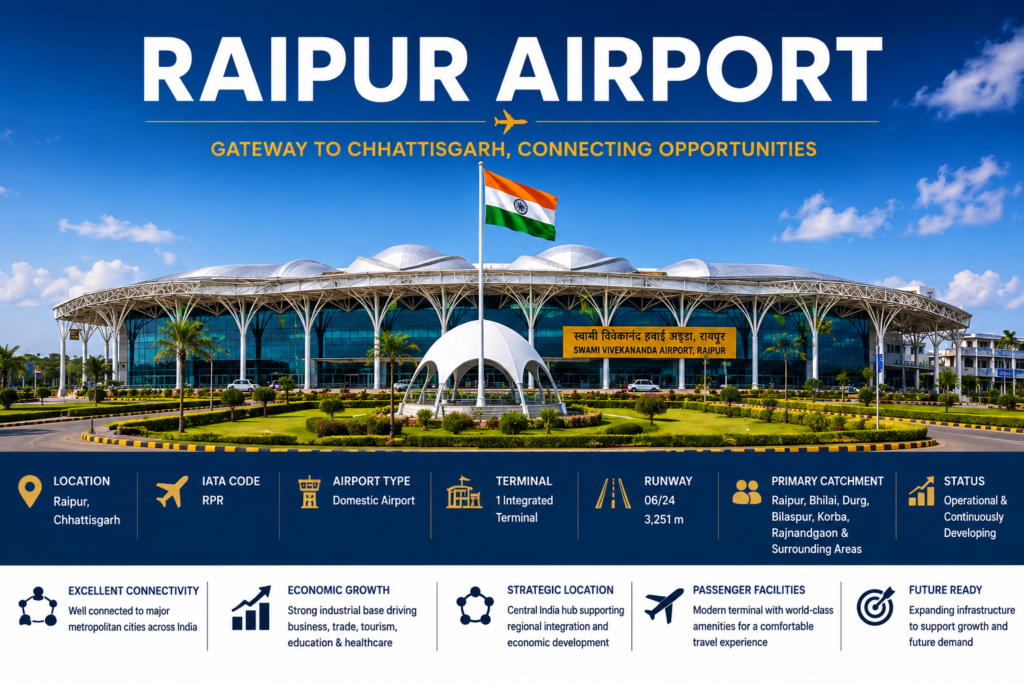
Swami Vivekananda Airport, formerly known as Raipur Airport, is the principal airport serving the state of Chhattisgarh. Established during the pre-independence era as a modest airstrip, the airport initially catered to limited civil and government aviation activities. Following the formation of Chhattisgarh as a separate state in 2000, Raipur emerged as the administrative and commercial capital, driving significant investments in aviation infrastructure to support the state’s rapid economic growth.
The Airports Authority of India (AAI) undertook a phased modernization program that included runway strengthening, apron expansion, installation of modern air navigation systems, and the construction of a new integrated passenger terminal. In recognition of the renowned philosopher and social reformer, the airport was officially renamed Swami Vivekananda Airport in 2012.
Today, the airport serves as the primary air gateway to Central India, facilitating business, government, industrial, tourism, and cargo movements while supporting the state’s expanding economy.
Airport Overview
Swami Vivekananda Airport is located approximately 15 kilometres south of Raipur city, providing seamless connectivity to Chhattisgarh’s capital and its surrounding industrial corridors. Operated by the Airports Authority of India (AAI), the airport serves scheduled domestic passenger services, cargo operations, charter flights, and government aviation activities.
The airport features a modern integrated passenger terminal equipped with aerobridges, spacious departure and arrival halls, retail outlets, food and beverage facilities, airline lounges, and passenger-centric amenities designed to accommodate increasing passenger volumes.
Raipur’s strategic location at the heart of India positions the airport as an important regional aviation hub connecting the northern, southern, eastern, and western parts of the country. The airport supports the movement of corporate executives, government officials, entrepreneurs, students, medical travellers, and tourists, making it a vital component of the state’s transportation infrastructure.
Its primary catchment extends across Raipur, Bhilai, Durg, Bilaspur, Korba, Rajnandgaon, Jagdalpur, and neighbouring regions of Madhya Pradesh, Maharashtra, Odisha, Telangana, and Jharkhand.
Airport Snapshot
| Parameter | Details |
| Airport Name | Swami Vivekananda Airport (Raipur Airport) |
| IATA Code | RPR |
| ICAO Code | VARP |
| Airport Type | Domestic Airport |
| Owner | Airports Authority of India (AAI) |
| Operator | Airports Authority of India (AAI) |
| Location | Raipur, Chhattisgarh |
| Elevation | Approximately 317 metres (1,040 ft) |
| Passenger Terminals | 1 Integrated Passenger Terminal |
| Runways | 1 |
| Runway Number | 06/24 |
| Runway Length | Approximately 3,251 metres |
| Runway Surface | Asphalt |
| Commercial Operations Started | Scheduled civil operations expanded significantly after the formation of Chhattisgarh in 2000, with the new integrated terminal commissioned in 2012 |
| Primary Catchment | Raipur, Bhilai, Durg, Bilaspur, Korba, Rajnandgaon, Jagdalpur, and adjoining regions |
| Major Airlines | IndiGo, Air India, Air India Express, Akasa Air |
Market Intelligence
Economic Landscape
Raipur is the commercial and administrative capital of Chhattisgarh, one of India’s most resource-rich states. The region is a major contributor to the country’s steel, mining, power generation, cement, and aluminium industries. Supported by abundant mineral reserves and industrial investments, the city has evolved into a significant manufacturing and logistics hub in Central India.
The airport benefits from consistent demand generated by industrial enterprises, public sector undertakings, infrastructure projects, government institutions, educational establishments, and healthcare services.
Passenger Profile
Swami Vivekananda Airport caters to a diverse passenger mix comprising:
- Corporate and business travellers
- Government officials
- Industrial professionals
- Students
- Medical travellers
- Tourists
- Visiting friends and relatives (VFR)
Business travel forms a substantial share of overall passenger traffic due to the concentration of industrial and administrative activities across the state.
Connectivity
The airport provides direct connectivity to major metropolitan cities including Delhi, Mumbai, Bengaluru, Hyderabad, Kolkata, Chennai, Pune, Ahmedabad, and other key domestic destinations. This extensive network supports business continuity, tourism, and regional economic integration.
Its central geographic location enhances accessibility for travellers from neighbouring districts and adjoining states.
Tourism Potential
While Raipur primarily serves business and government travel, it also acts as the gateway to several important tourism destinations across Chhattisgarh, including:
- Chitrakote Falls
- Tirathgarh Falls
- Sirpur Archaeological Site
- Barnawapara Wildlife Sanctuary
- Kanger Valley National Park
- Dongargarh Temple
- Bastar Cultural Region
Growing interest in eco-tourism, heritage tourism, tribal culture, and religious tourism continues to support leisure travel through the airport.
Cargo and Logistics
The airport plays an important role in supporting regional logistics by facilitating the movement of:
- Engineering equipment
- Industrial machinery
- Pharmaceuticals
- Agricultural produce
- E-commerce shipments
- Time-sensitive commercial cargo
With continued industrial expansion and infrastructure development, cargo operations are expected to witness steady growth.
Infrastructure Development
Swami Vivekananda Airport continues to strengthen its operational capabilities through infrastructure upgrades focused on improving passenger experience, operational efficiency, and future capacity requirements. Ongoing developments support the airport’s role as a critical transportation asset for Central India.
SirriS Intelligence Summary
Airport Positioning
Swami Vivekananda Airport serves as the primary aviation gateway to Chhattisgarh and is one of Central India’s most strategically significant regional airports. Its strong industrial catchment, administrative importance, and expanding domestic connectivity position it as a key driver of regional economic development.
Key Strengths
- Principal airport serving the state of Chhattisgarh
- Strong industrial, mining, and manufacturing catchment
- Capital city airport with significant government travel
- Modern integrated passenger terminal
- Extensive connectivity to major Indian metropolitan cities
- Balanced mix of business, government, leisure, and VFR traffic
- Strategic location supporting Central India’s economic corridor
Growth Drivers
- Continued industrial and infrastructure investments
- Expansion of domestic air connectivity
- Rising passenger demand from business and government sectors
- Growth in tourism across Chhattisgarh
- Increasing cargo and logistics requirements
- Regional economic diversification and urban development
Future Outlook
As Chhattisgarh continues to attract investments across manufacturing, mining, infrastructure, logistics, and services, Swami Vivekananda Airport is expected to play an increasingly important role in supporting the state’s economic ambitions. With sustained improvements in infrastructure, connectivity, and passenger services, the airport is well positioned to strengthen its status as a leading regional aviation hub in Central India.